











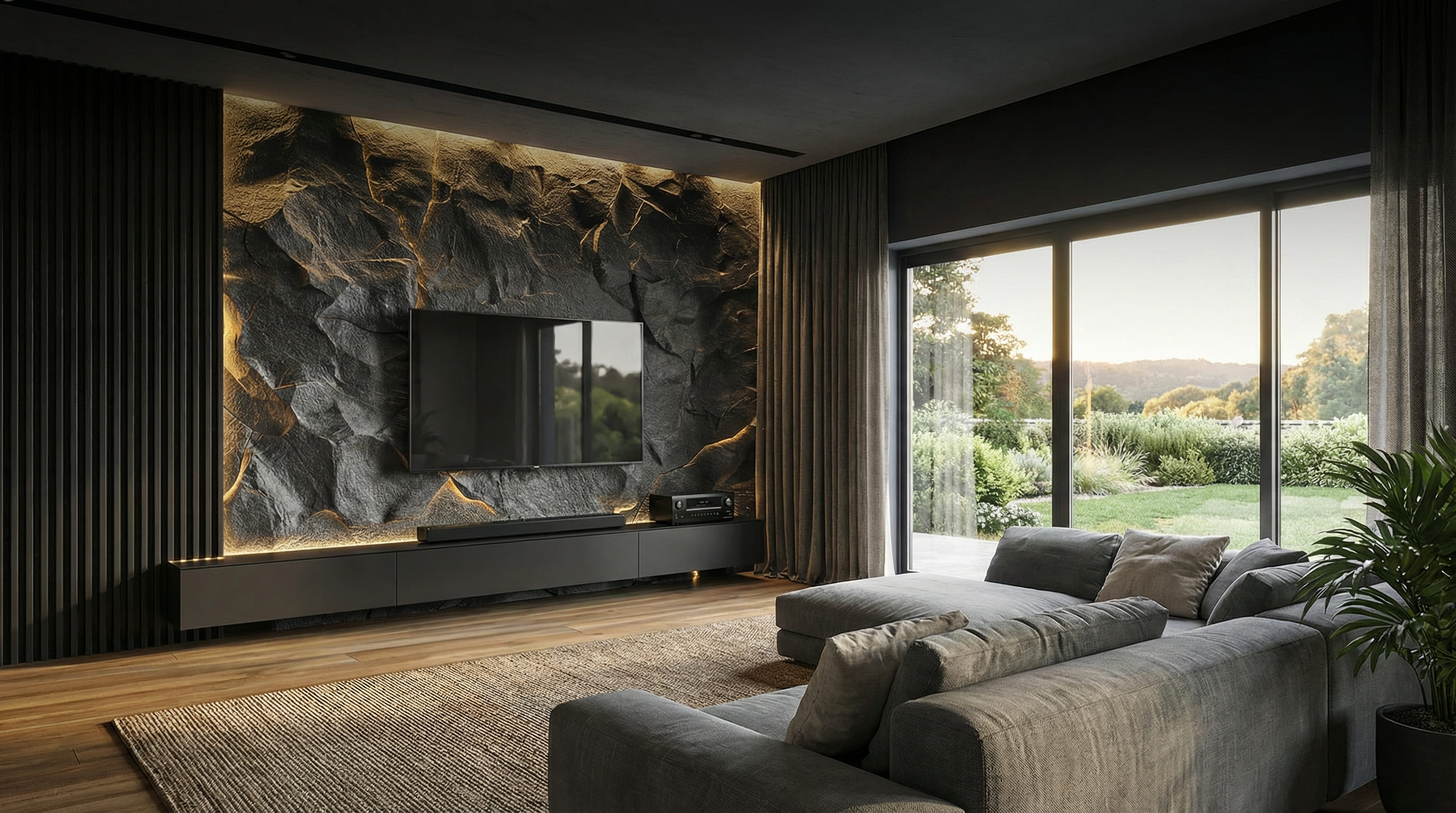


No one voluntarily completely empties a fully furnished living room to re-lay cables or move the TV wall. During a move, exactly that happens naturally. Those who seize this opportunity with a plan save themselves the compromises that others live with for years.
Recent Posts
- Round Marble Dining Table: The Secret to Dynamic Space
 Round Marble Dining Table: The Secret to Dynamic SpaceDiscover how the combination of cool natural stone and warm wood redefines the center of your home and how to perfectly stage a round table.
 - Decorating Empty Corners & Open Spaces: The Architectural Sideboard Solution
 Decorating Empty Corners & Open Spaces: The Architectural Sideboard SolutionFrom smart room dividers to minimalist media walls: Discover three ways the Punt Velasca Sideboard transforms open living concepts.
 - Livitalia Rondo: The Curved Design Trend Redefining Modern Living
 Livitalia Rondo: The Curved Design Trend Redefining Modern LivingFlowing lines instead of sharp corners: How the current trend towards organic forms transforms the modern bedroom into an oasis of calm.
 - Tall Chest of Drawers: 8 Smart Styling Ideas for Hallways, Bedrooms & Stairwells
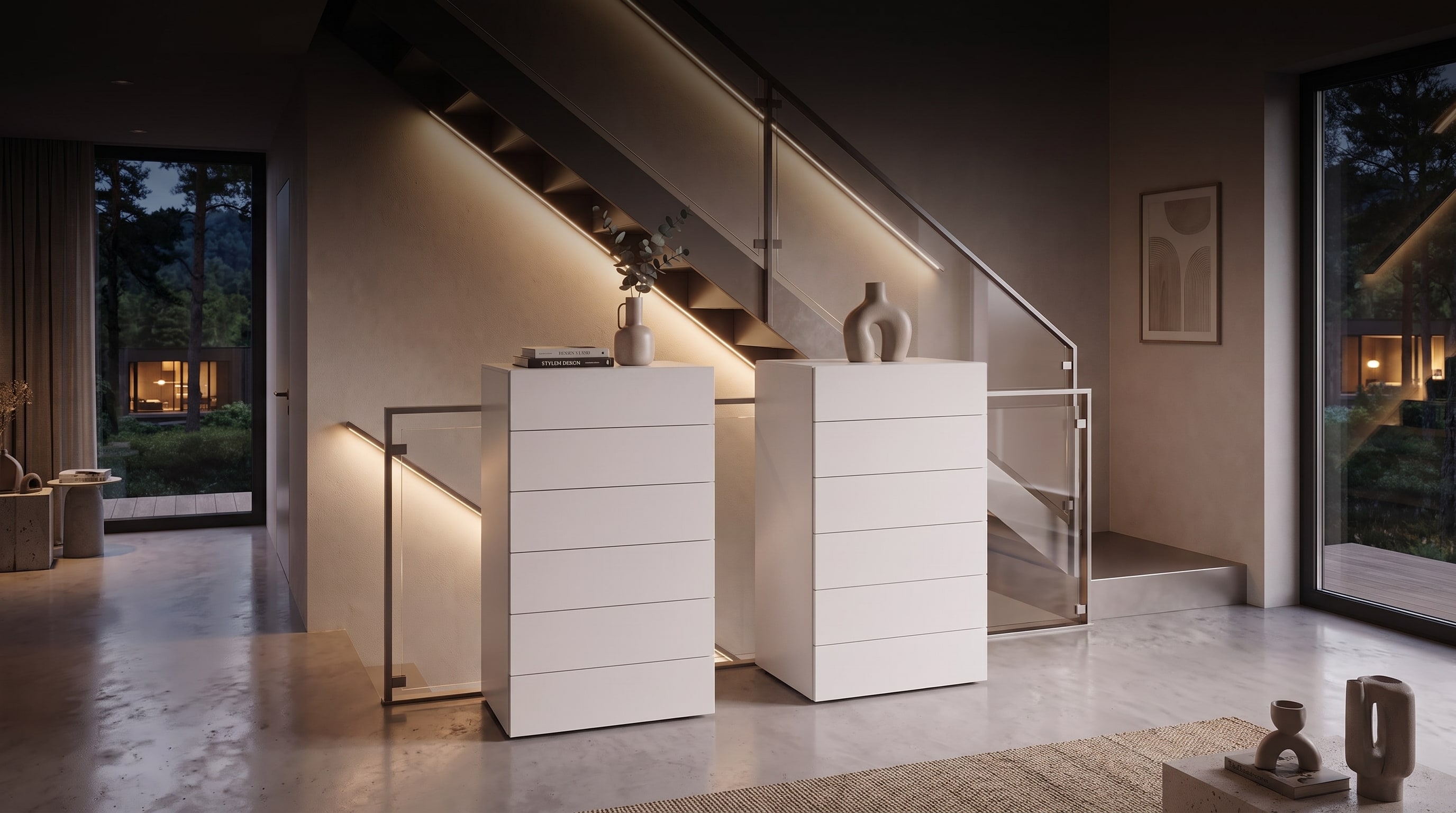 Tall Chest of Drawers: 8 Smart Styling Ideas for Hallways, Bedrooms & StairwellsDiscover how a modern tall chest of drawers transforms narrow rooms and unused corners into stylish storage wonders.
 - Luxury Custom Wardrobe: Uncover Your Hidden Beauty Niche
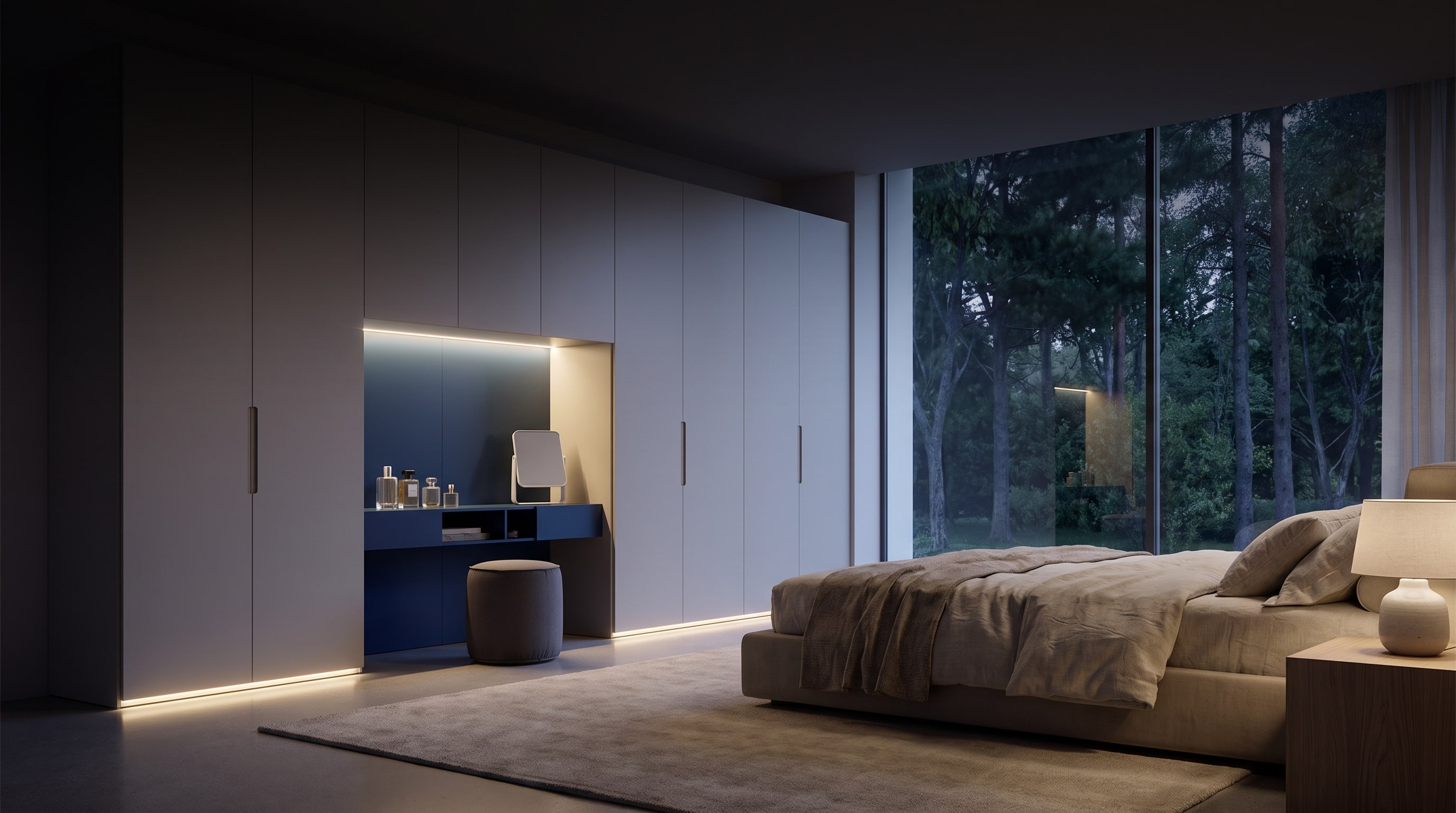 Luxury Custom Wardrobe: Uncover Your Hidden Beauty NicheA tidy bedroom radiates calm – but where do perfume, jewelry, and mirrors go? The solution lies in an intelligently planned wardrobe niche.
New Home Setup: Your 9-Step Living Room Plan After Moving
Moving house reopens every furnishing question – and that's an opportunity, not a burden. The new flat has different walls, different light, a different layout. What grew organically over years in the old flat can now be consciously decided.
This plan guides you through your new living room in nine steps – in the order in which decisions truly arise during a move: from measuring before moving day, through zones, technology, and acoustics, to surfaces that will withstand the stress of moving in without a trace.
A move is the only opportunity to plan a living room from scratch.
1. Measure before moving: The Width Formula for your new living room
The most important decision for your new living room isn't made on moving day, but weeks beforehand – with a tape measure in your old flat. Because whether your TV unit can come with you or will immediately look wrong in the new flat is decided by a single number.
The Width Formula is: Furniture width = TV width plus at least 25 cm clearance on each side. This clearance isn't a luxury, but the reason why a large television appears calm and commanding in some living rooms – and top-heavy in others, as if it would tip over at any moment.
| TV Size | TV Width (16:9) | Recommended Furniture Width |
|---|---|---|
| 55 inches | approx. 122 cm | from 170 cm |
| 65 inches | approx. 144 cm | from 195 cm |
| 75 inches | approx. 166 cm | from 215 cm |
| 85 inches | approx. 188 cm | from 240 cm |
| 100 inches | approx. 221 cm | 270–300 cm |
The honest consequence before moving: Most lowboards stop at 180 cm. If you want to upgrade to 75 inches or more in your new flat – and a larger living space is often the very reason – you shouldn't drag the old furniture along, but instead plan for a configurable width that goes beyond the standard.
💡 Livarea Expert Tip:Before moving, schedule a tape measure appointment in your new flat: measure the TV wall, mark sockets and antenna connection, take a photo. Ten minutes that will save you hundreds of euros in wrong purchases later.
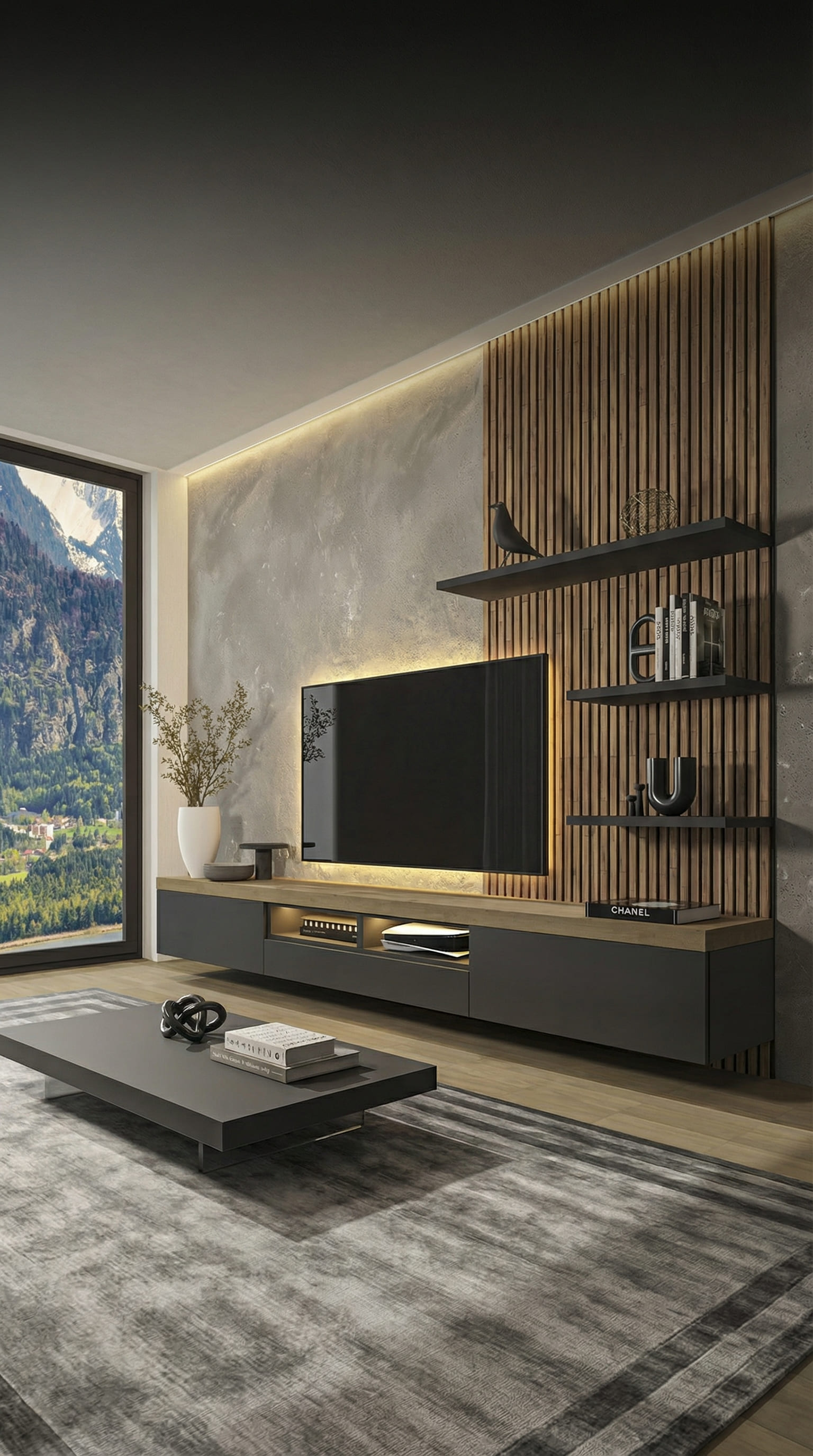
For exactly this situation, we have configured the Livitalia Media Storage TV Lowboard Schwarz Matt. It can be precisely planned for the new wall up to 300 cm wide – wall-mounted, so the room appears larger from day one.
2. Empty flat, open-plan layout: Establish zones before the boxes arrive
The moment your new flat is still empty will never come again. Right now – before the first box – it's worth looking at the floor plan: Where will you live, where will you eat, where will you work? Anyone who simply puts furniture 'just anywhere for now' on moving day knows from experience: that's where it will stay for years.
Open-plan layouts and lofts, in particular, need this decision early. There are no walls, and massive cabinet walls would destroy the spaciousness for which you chose the flat. The more elegant solution is a piece of furniture that defines zones without closing off the space.
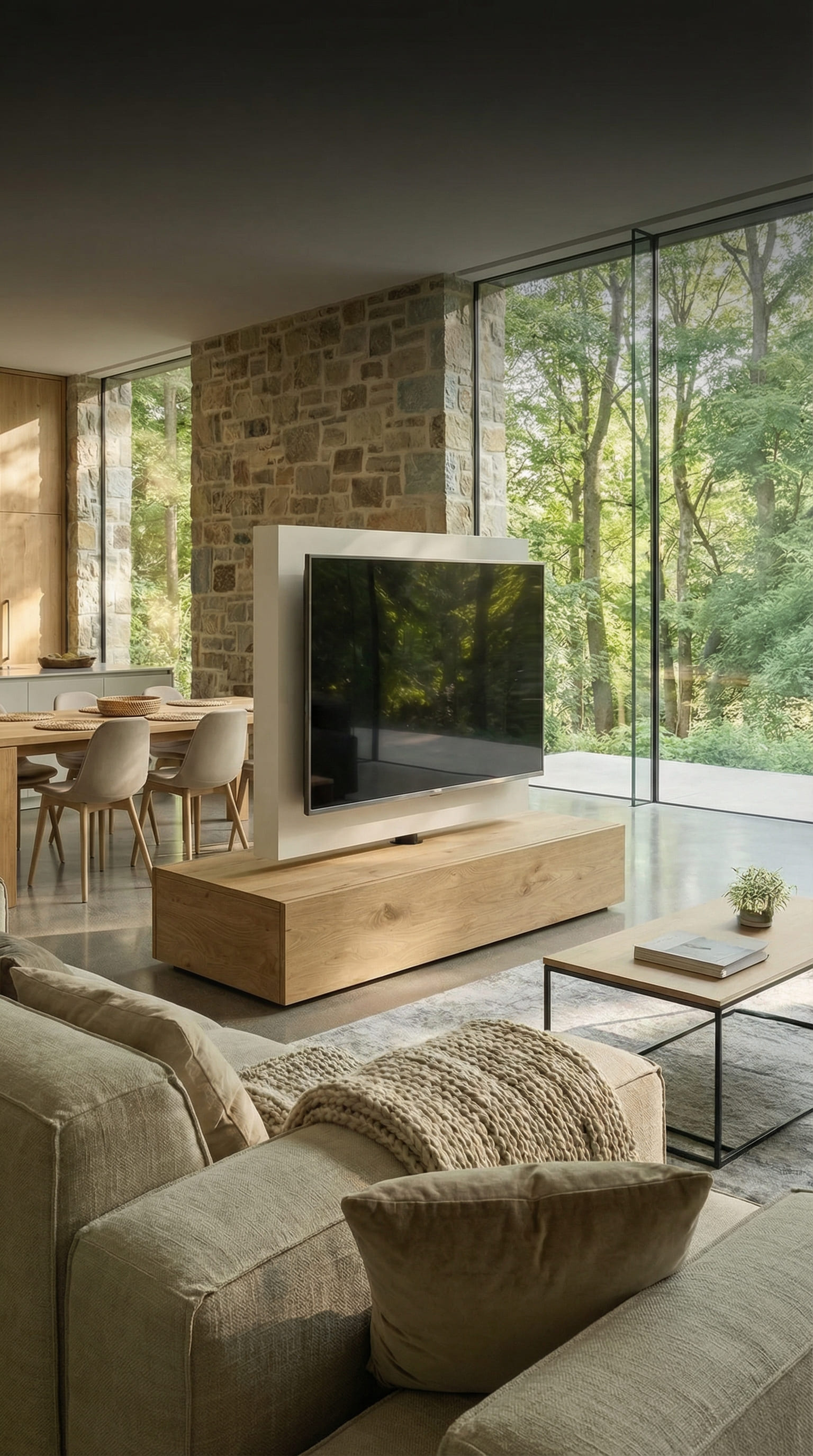
The Roto TV Room Divider is the classic choice for this: It stands freely in the room, separating the living area from the rest – and the swivelling TV panel serves both sides. This keeps the view through the window front clear, and the zone is still clearly defined.
💡 Livarea Expert Tip:Tape out the planned furniture footprints on the floor of the empty flat with painter's tape and walk the paths: sofa to kitchen, door to balcony. What looked good on the floor plan will be exposed by your own walk-through in two minutes.
3. The Placement Test: Check sightlines in the new layout
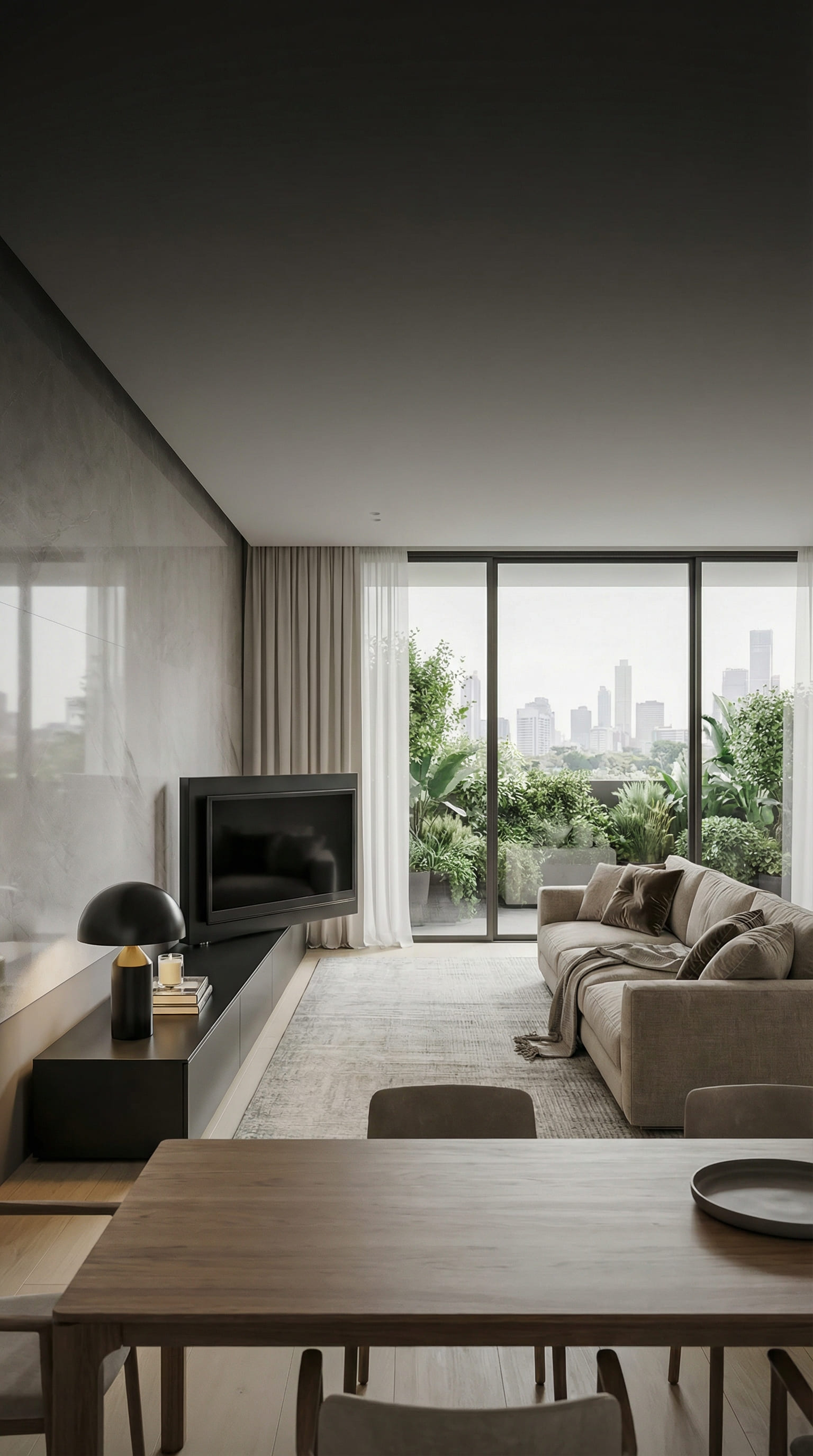
After defining the zones comes the crucial question of every move: Where to put the TV? In modern layouts, the kitchen, dining area, and living room flow seamlessly into one another – and suddenly there isn't just one TV wall, but three candidates, each with a catch.
The mistake would be to commit on moving day. Test the sightlines in the still-empty room: Where do you really sit in the evenings? Can you see the screen from the dining table? Does the window front reflect? In the old flat, this had evolved over years – in the new one, you can consciously decide.
If you don't want to commit to one axis, solve it mechanically: The Livitalia Vision Lowboard swivels the TV by 90 degrees – movie night towards the sofa, football towards the dining table. Especially in an open-plan layout, this is the answer to the question that would otherwise remain open for years.
4. Unpack Tech Systematically: Route Cables Properly Once
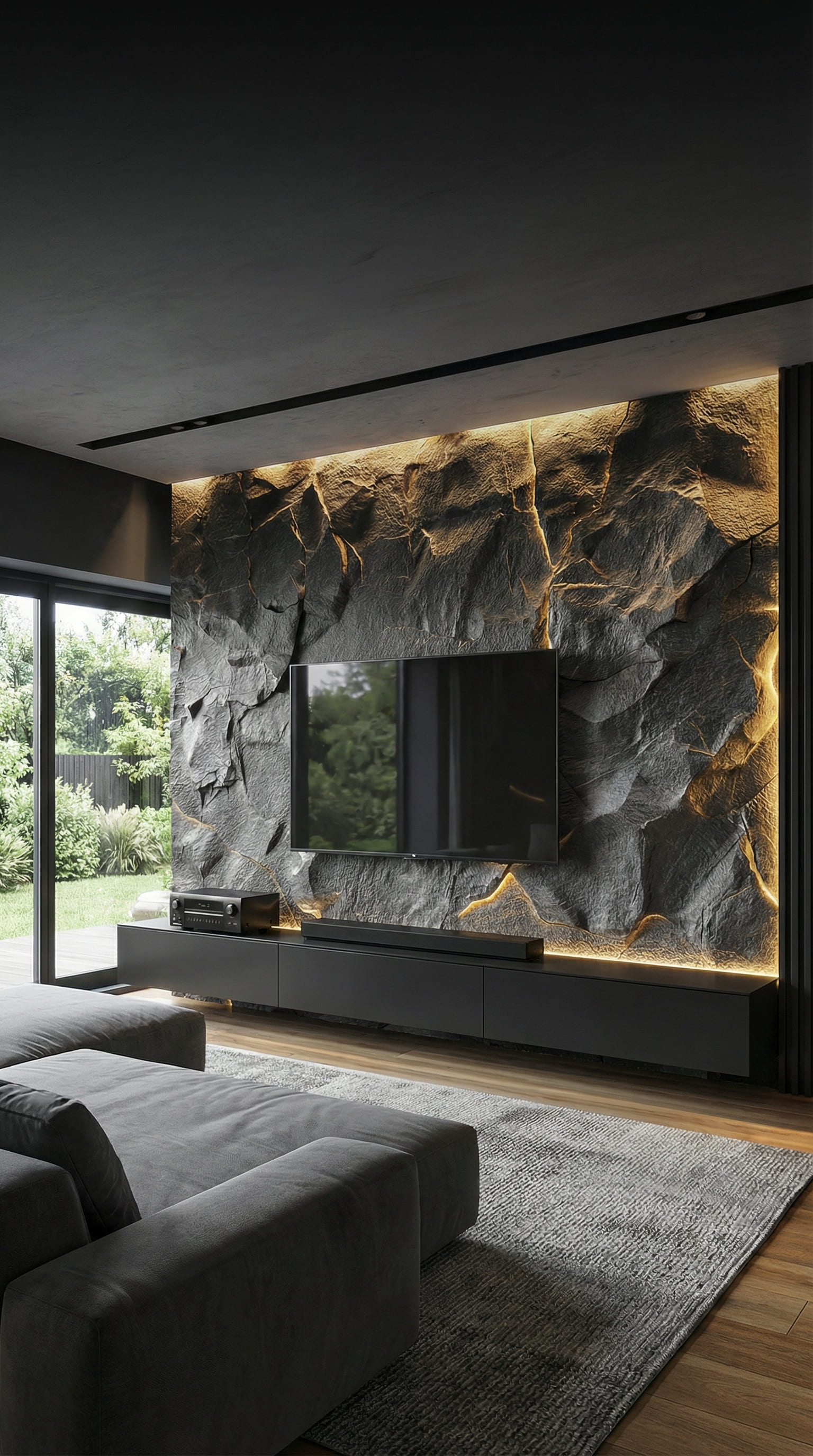
There is exactly one day in the life of a living room when all cables are simultaneously exposed: moving day. Anyone who simply unpacks the tech boxes 'later' will take the cable chaos of the old flat directly into the new one.
That's why the tech question belongs in your moving plan: first decide where the console, receiver, and router should live – then cable them, just once, neatly. Visible tech is no longer a flaw: a games console or a high-quality amplifier can be displayed like a design object.
The Modern TV Wall Unit Idea C101 is built precisely for this: an open compartment as a stage for your tech, with clever cable management behind it – the devices get the spotlight, the chaos remains invisible.
💡 Livarea Expert Tip:When dismantling in your old flat, label each cable with masking tape (HDMI 1 → Console, Optical → Soundbar). Reassembly will then take minutes instead of half a Saturday.
5. The Overlooked Detail: Why Your Receiver and Console Need Air
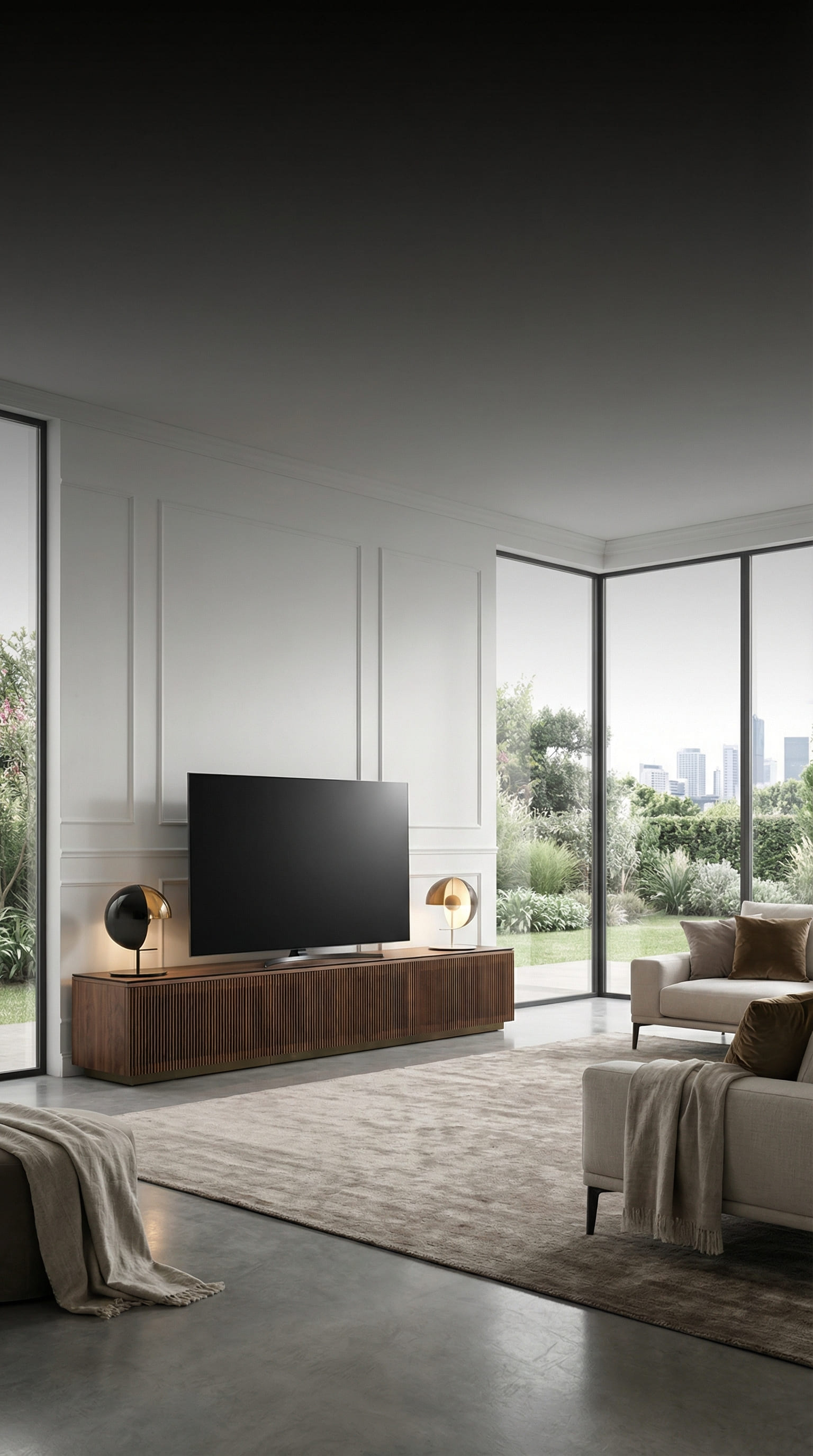
When unpacking, a mistake often happens that you only notice months later: AV receivers, streaming boxes, and power amplifiers disappear behind the first available closed front. Heat builds up there – and the devices 'thank' you with fan noise, throttling, or early failure.
Your new flat is an opportunity to get this right from the start. The solution doesn't have to look technical: slatted fronts are the most elegant form of ventilation known to furniture design – air circulates, infrared signals from the remote control pass through, and the front remains visually calm.
The Punt Malmö Design TV Lowboard with its walnut slatted front shows what this looks like: Scandinavian tidiness on the outside, a ventilated home for all your tech on the inside. This way, you only need to set it up once – with no need for modifications after the first hot summer.
6. The Echo Chamber: How to Tame Acoustics in Your New Flat
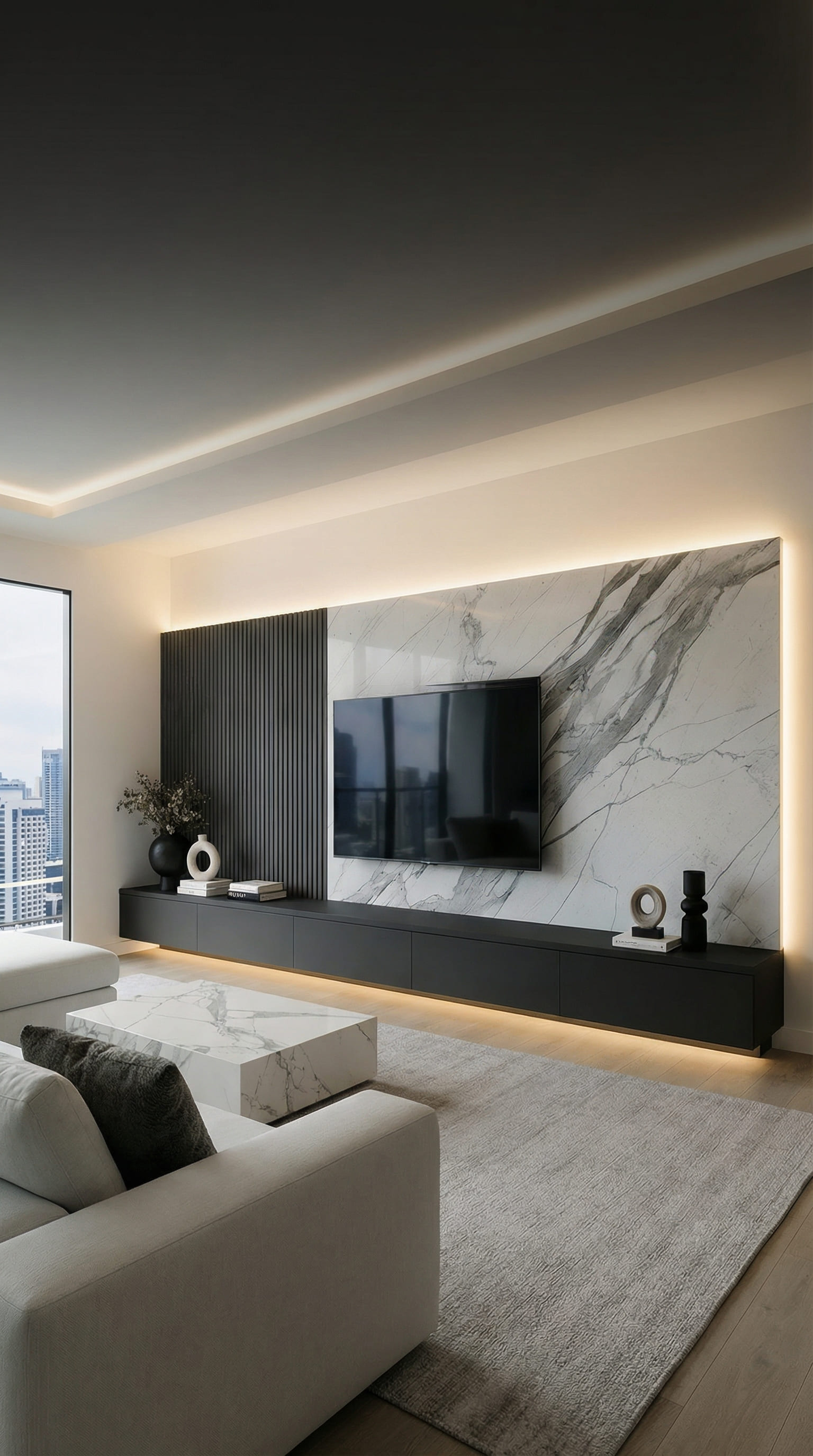
Everyone knows that moment: the first night in a new flat, you speak a sentence – and the room throws it back. Empty rooms echo, and in modern flats with glass, screed, and smooth walls, this echo never quite disappears on its own, even after furnishing.
Carpets and curtains help, but the wall behind the television is the underestimated lever: A structured wall design with acoustic slats absorbs precisely the reflections that make film dialogues tiring – and incidentally transforms the TV wall from a functional area into the room's architectural statement.
If you need a lot of storage space anyway, combine both: The Livitalia Wall Unit with Marble Wall Panel is planned to the millimetre for your new wall – acoustic panels, marble surface, and closed storage in one concept. The room sounds dampened and feels complete from the very first evening.
7. Declutter, Don't Drag: Your Move as a Fresh Start
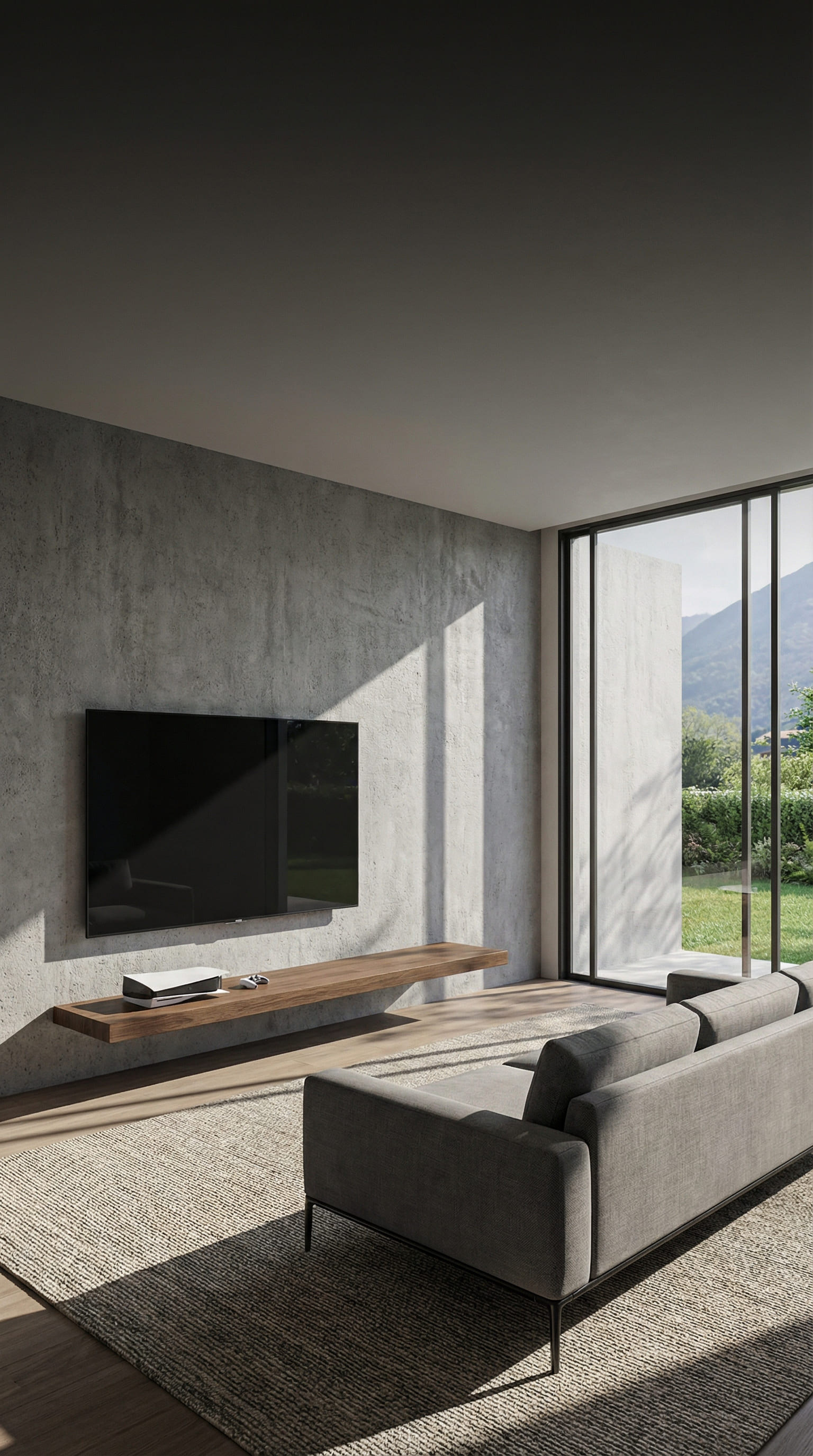
The hardest, but most honest moving rule: What was just standing around in the old flat won't look any better in the new one. Moving is the only opportunity when every item is in your hand anyway – the perfect moment to ask if it can come with you.
Those who radically declutter will be rewarded with a living feeling that no decoration in the world can create: peace. In its most consistent form, the living room doesn't even need a classic piece of furniture under the TV – a floating shelf is enough.
The Brown Oak Wall Board is this reduction in furniture form: a dark oak surface on the wall, nothing more. The floor underneath remains free – and the new flat retains the lightness of the first viewing.
💡 Livarea Expert Tip:The Box Test: What's still unpacked in the new flat after eight weeks wasn't missed. Sell it, give it away – don't store it.
8. Settling In: Bringing Warmth and Character to Your New Home
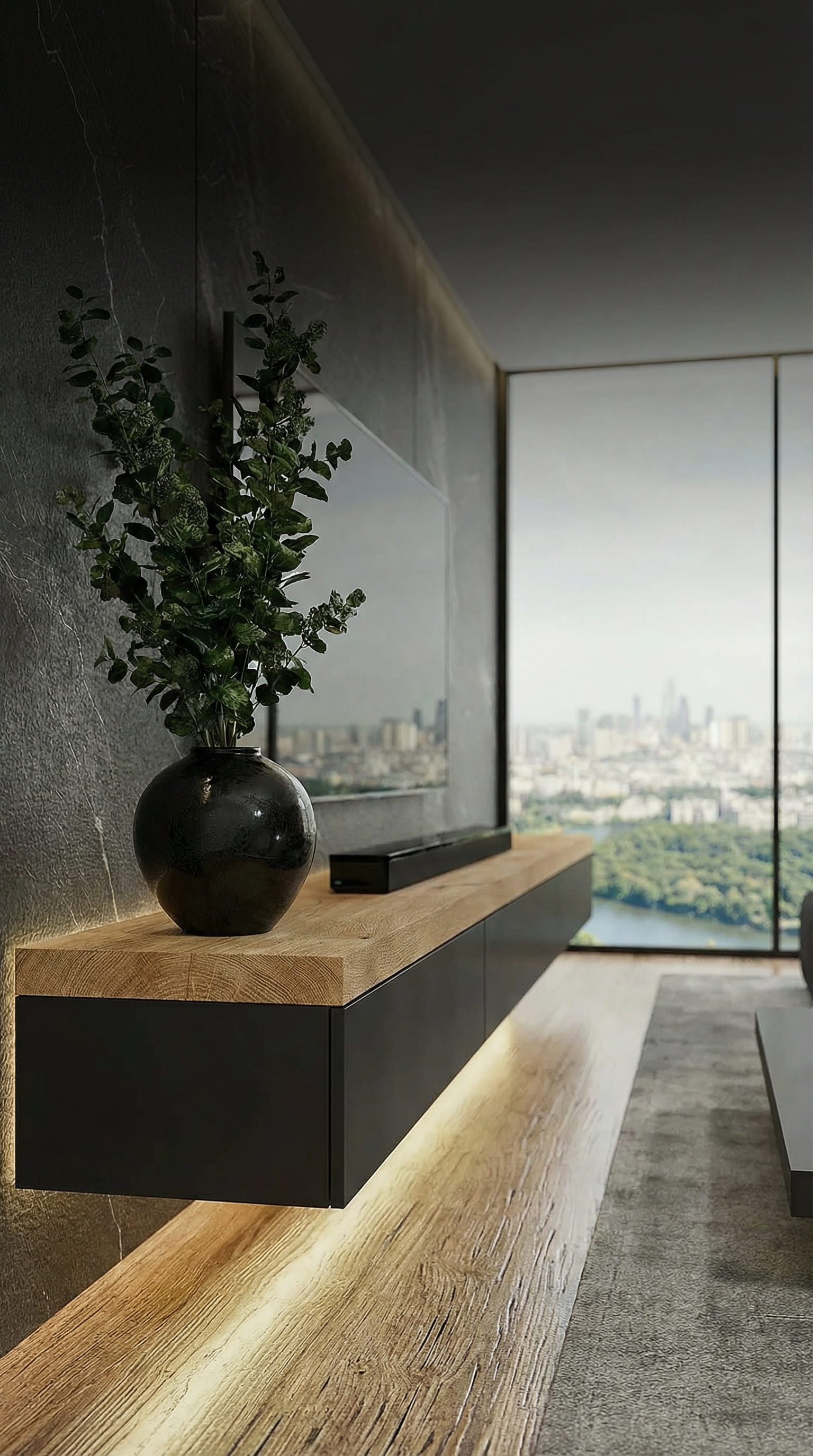
Eventually, the boxes are empty, the tech is running, the echo is tamed – and yet the flat still isn't a home. What's missing is warmth. Especially new builds with white walls and grey flooring need a material that gives the room character.
Oak is the safest choice for this – when used in a modern way. The fear many movers have of automatically ending up with a rustic country house look with wood is unfounded: the combination of a warm wooden surface and a dark, linear carcass appears cosy and architectural at the same time.
The Livitalia Lowboard with Thick Top Panel brings exactly this balance to the new living room: the striking oak top panel is the first thing guests will touch at the housewarming party – the dark carcass underneath keeps the look modern.
9. Moving Stress Without a Trace: Surfaces That Stay Clean
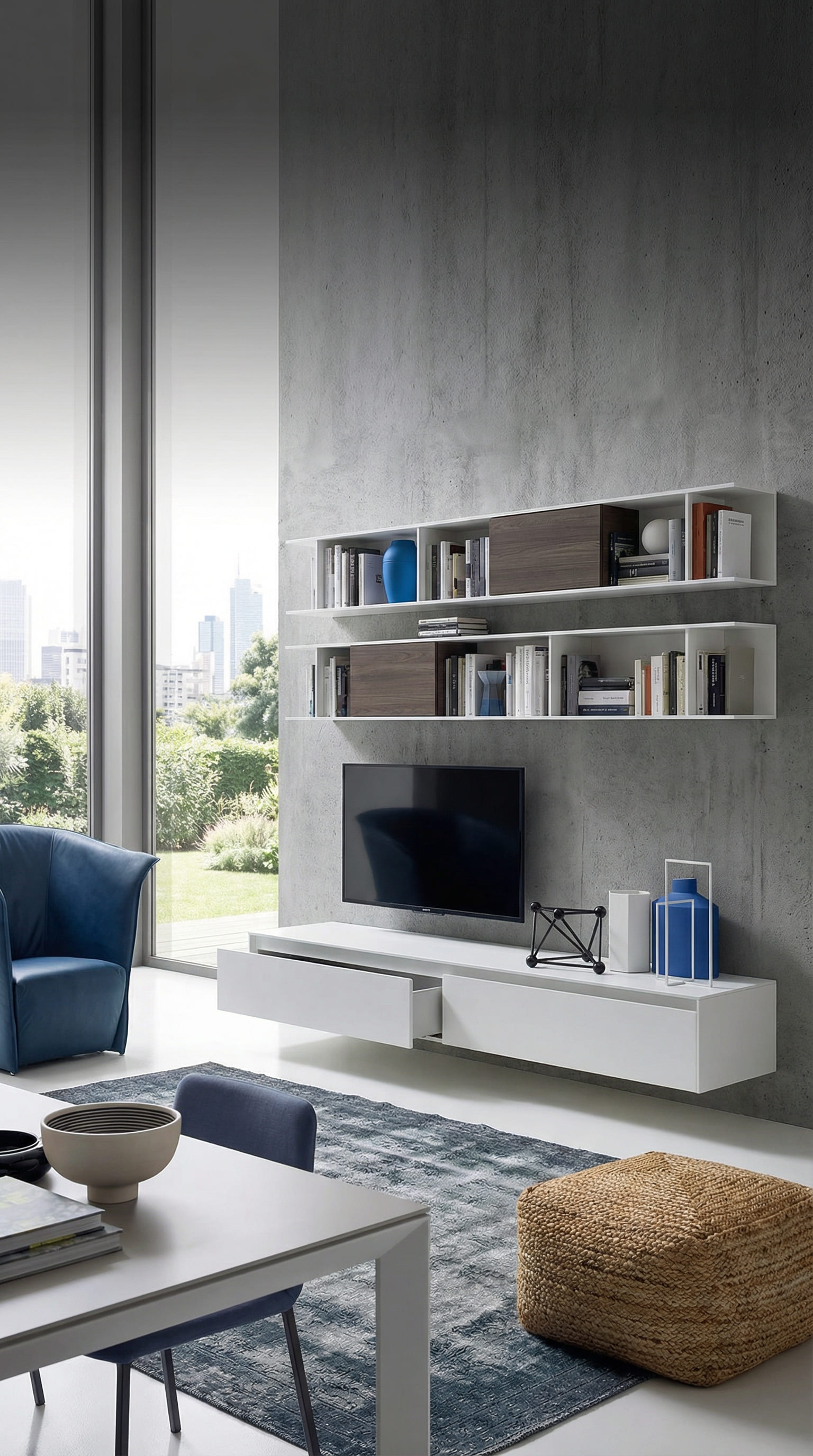
In the first few weeks after moving, the living room will be touched, moved, and rearranged more than in the five years that follow. Matt furniture fronts look fantastic – until fingerprints everywhere document the move-in.
Therefore, anyone choosing matt lacquer for new purchases for their new home should look for anti-fingerprint surfaces: they absorb light like classic matt lacquer but can be wiped clean without leaving smudges or streaks. Handleless fronts enhance the effect because no one pulls in the same spot.
The Reverse Design Lowboard White Matt combines both: a velvety, resilient surface and an integrated handle strip. This way, the furniture withstands the stress of moving in just as flawlessly as everyday life afterwards.
The Moving Plan at a Glance: Your Path to the New Living Room
First measure, then zone, then test sightlines – and neatly wire up the tech just once: Anyone who follows this order will furnish their new flat in weeks, in a way others fail to achieve in years. Ventilation, acoustics, and the right surface then determine whether the living room is merely furnished or truly finished.
Whether it's a configurable lowboard in an exact wall width, a rotating room divider for an open-plan layout, or a custom-designed living room wall unit with an acoustic panel: At Livarea, you'll find the furniture that translates the 9-step plan into your new home. Our interior design consultants will plan directly with your floor plan upon request – so that your new flat feels like home from the very first evening.

Mira Celini
Interior Designer at LivareaAs an Interior Designer at Livarea – one of Germany's leading online shops for designer furniture since 2012 – I assist customers with furnishing their homes. My tips come directly from practical experience: honest, inspiring, and always with an eye for the extraordinary.
→ View all Trendblog articlesFrequently Asked Questions
Which furniture should you measure before moving?
First, the television and its furniture: According to the width formula, the TV unit needs the TV width plus at least 25 cm per side – so for 75 inches, that's from 215 cm. Then check sofas and cabinets against the new wall dimensions and don't forget: door widths, hallway, and staircase determine what can actually enter the new flat.
In what order should you furnish a living room after moving?
First define the zones in the empty room, then place the large furniture, then neatly wire up the tech once – and only then deal with acoustics, decoration, and finishing touches. Anyone who starts with the boxes instead of the floor plan will live for years with the temporary setup of moving day.
Will the old TV unit fit in the new flat?
The width formula provides the answer before moving day: If the unit is narrower than TV width plus 25 cm per side, the television will look top-heavy on it – especially when upgrading to 75 or 85 inches. In that case, moving the unit isn't worthwhile; instead, opt for a configurable width for the new wall.
What helps against echo in a new flat?
Empty rooms always echo – carpets, curtains, and upholstered furniture absorb the roughest reverberation. If the room remains acoustically challenging even when furnished, the wall behind the television is the most effective lever: Acoustic slats or textured wall panels absorb precisely the reflections that make dialogue sound harsh.
Comment area
Comments are disabled for this article
